01 PE PROCESS-ROUTE COMPARISON
Cast PE vs blown PE film: specify the process route before the property claim
Cast and blown describe how a film is formed, not a complete PE grade or guaranteed property set. Name the route when it matters, then keep resin, layer design, orientation, surfaces, dimensions, test conditions and converter behavior as separate RFQ fields.
02 DECISION FRAME
Process route is traceability data—not a shortcut to performance
Official equipment sources distinguish flat-die cast systems from blown-film systems using an annular die and bubble. ASTM PE-film sources identify further specification and test fields. None of those sources proves the construction, capability or performance of a LayerSource offer; the exact supplier grade and trial record must answer that question.
- A PE film enquiry where the converter requires cast or blown manufacture
- A replacement project where the current route or layer construction affects runnability
- A quote comparison that is mixing process labels with unsupported property assumptions
- That all cast PE films share one optical, mechanical, sealing or gauge profile
- That all blown PE films share one toughness, shrink or directional response
- That equal resin family and thickness make two constructions interchangeable
03 COMPARISON MAP
Record the formation route, then qualify the actual construction
Use the route to ask better questions. Do not fill grade-specific cells from general process descriptions.
Swipe or scroll horizontally to review every evidence column.
| Decision field | Cast PE route | Blown PE route | Evidence to request |
|---|---|---|---|
| Formation route | Flat-die extrusion followed by the line’s cooling and winding sequence | Annular-die extrusion followed by bubble, collapsing, layflat and winding stages | Supplier process declaration for the exact grade and production route |
| Layer construction | Mono- or multilayer construction must be identified | Mono- or multilayer construction must be identified | Layer count, functional-layer assignment and any controlled composition statement |
| Direction map | Mark machine and transverse directions from the production web | Mark machine and transverse directions plus the layflat reference | MD / TD specimen map, slit position, roll orientation and test direction |
| Working surfaces | Identify each treated, printed, laminated or sealing surface | Identify inside / outside bubble history only when documented, then map working surfaces | Side-labelled sample and actual ink, adhesive, coating or seal interface |
| Dimensions and roll | Specify thickness profile, width, core, winding and roll limits | Specify thickness profile, slit web, width, core, winding and roll limits | Method, sampling positions, tolerance agreement and receiving record |
| Performance | Treat sealing, COF, optics, mechanical and barrier results as grade-specific | Treat sealing, COF, optics, mechanical and barrier results as grade-specific | Identified specimen, method, conditions, direction, age and converter trial |
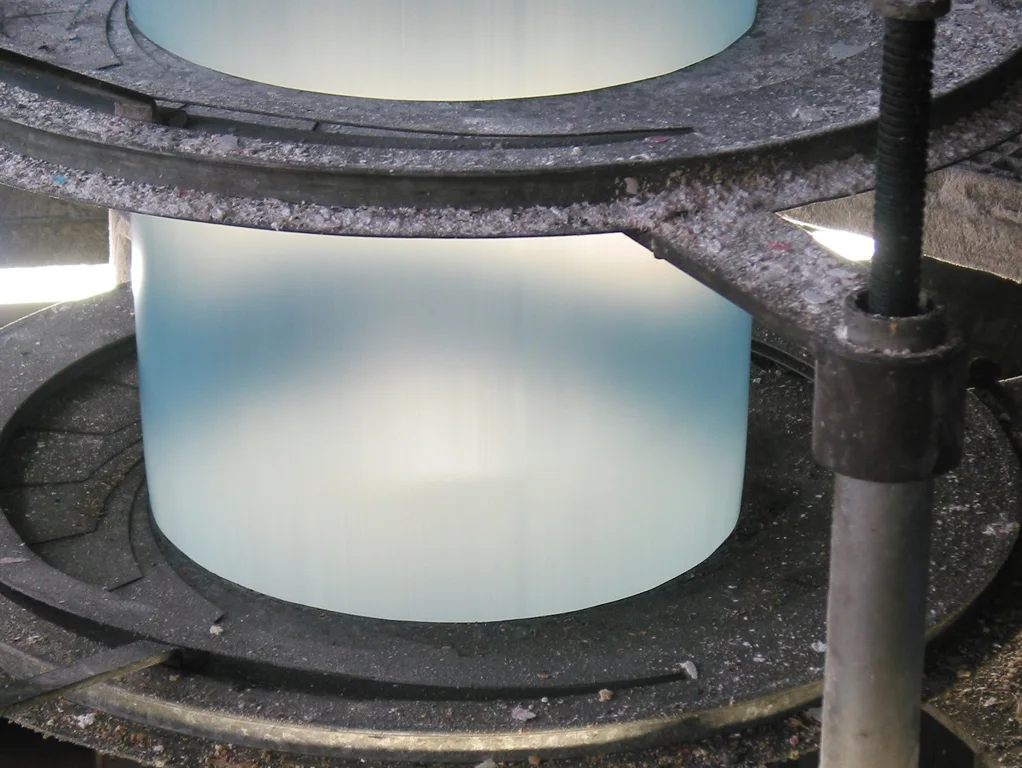
Keep the process route attached to the roll record.
This licensed photograph shows part of a blown-plastic-film extrusion setup. It illustrates the bubble-forming route only: the source does not identify a PE resin, grade, layer construction, dimensions or performance. It is not a LayerSource facility, supplier, inventory, partnership, endorsement or manufacturing claim.
Source: “Film extrusion” by Maarten Gielen, CC BY-SA 4.0. Cropped and converted to WebP; no visual retouching.04 SELECTION SEQUENCE
Move from a broad comparison to an approvable decision.
Confirm whether route is controlled
If cast or blown manufacture is mandatory, write it as a traceable requirement. If it is not mandatory, state the measurable outcome and remain open to a documented recommendation.
Map layers, sides and directions
Carry the production route into a side-labelled sample, MD / TD map, slit position and unwind diagram before testing or conversion.
Run the same acceptance plan
Compare candidate grades using equivalent specimens, methods, conditioning and line conditions, then retain the result with the supplied lot.
05 RFQ INPUTS
Cast PE vs blown PE RFQ checklist
Separate mandatory route information from the measurable outcome the film still has to prove.
Open the RFQ brief builder ↗- 01
Packed product, complete structure, PE layer position and assigned function
- 02
Cast, blown or open-to-recommendation status and the reason for that requirement
- 03
Supplier, exact grade, resin or construction family and layer design if disclosed
- 04
Production-web MD / TD, layflat or slit reference and unwind direction
- 05
Treated, print, lamination, product-contact and seal surfaces
- 06
Thickness, width, profile or sampling basis, method, unit and tolerance agreement
- 07
Core, winding, roll limits, edges, splices, packing and traceability
- 08
Seal, COF, optical, mechanical or barrier requirement with test conditions
- 09
Current line issue, equipment, speed, tension, sealing and downstream process
- 10
Sample construction, trial plan, finished-pack criteria and change-control requirement
06 EVIDENCE BOUNDARY
Route descriptions do not create a LayerSource grade claim
The Davis-Standard pages show equipment-level differences between cast and blown film lines. ASTM D2103 and D4635 provide PE-film specification context. They do not establish what a supplier makes, what LayerSource can source or which route wins for an application. Confirm the exact construction and validate it under the agreed method and line conditions.
07 BUYER QUESTIONS
Resolve the assumptions that make quotes diverge.
01Is cast PE always clearer or blown PE always tougher?+
Those are not safe purchasing conclusions from the route name. Resin, layer design, additives, thickness, processing and test conditions can change the result. Request grade-specific evidence and run the intended conversion.
02When should the RFQ make cast or blown manufacture mandatory?+
Make it mandatory only when the existing process, specification, regulatory file or validated conversion requires that traceable route. Otherwise describe the required outcome and allow a documented recommendation.
03How should MD and TD be marked on blown PE film?+
Ask the supplier to identify the production machine direction, transverse direction, layflat or slit reference, working sides and unwind direction on the sample and roll record.
04Can equal-thickness cast and blown PE films be direct substitutes?+
Not from thickness alone. Compare construction, surfaces, direction-dependent data, sealing, COF, dimensions, roll build and the same line and finished-pack acceptance plan.